How to Create a Business App Development Plan That Actually Works
In today's digital-first business landscape, having a mobile or web application is no longer a luxury—it's a necessity for staying competitive. Yet, according to industry research, approximately 70% of digital transformation projects fail to meet their objectives, with poor planning being a primary culprit. At FlutterFlow Agency, we've seen firsthand how a comprehensive app development plan separates successful projects from costly failures. This definitive guide will walk you through creating a business app development plan that actually delivers results, covering everything from initial concept to post-launch optimization.
A business app development plan serves as your strategic blueprint—a living document that aligns technical execution with business objectives, manages resources effectively, and mitigates risks throughout the development lifecycle. Whether you're a startup founder, business owner, or agency leader, this guide provides the actionable framework you need to transform your app idea into a successful digital product.
Understanding the Foundation: Why Planning Matters
Before diving into the specifics of creating your plan, it's crucial to understand why thorough planning is non-negotiable for app development success. The mobile app market continues to expand exponentially, with over 255 billion app downloads projected for 2024. However, the competition is fierce, and user expectations have never been higher. A well-structured development plan addresses several critical challenges:
First, it establishes clear alignment between your business objectives and technical execution. Too often, businesses invest in app development without a clear understanding of how the app will drive value. According to a recent survey by Gartner, organizations that align their digital initiatives with business goals are 2.5 times more likely to achieve their desired outcomes.
Second, effective planning manages stakeholder expectations and communication. Your development plan serves as a single source of truth for all parties involved—from executives and investors to development teams and marketing departments. This alignment prevents scope creep, budget overruns, and timeline delays that plague poorly planned projects.
Third, a comprehensive plan identifies and mitigates risks early in the process. From technical constraints to market shifts, anticipating challenges allows you to develop contingency strategies rather than reacting to crises. Our experience at FlutterFlow Agency shows that projects with thorough risk assessment during planning phase experience 40% fewer major setbacks during development.
Defining Your Business Objectives and Success Metrics
The foundation of any effective app development plan begins with crystal-clear business objectives. What problem does your app solve? Who benefits from its existence? How will it generate value for your organization? These questions must be answered before any technical decisions are made.
Start by conducting a thorough business analysis. Identify your target market segments, analyze competitor offerings, and determine your unique value proposition. For example, if you're developing a retail app, your objectives might include increasing online sales by 25%, reducing customer service inquiries by 30%, or improving customer retention by 15%. Each objective should be specific, measurable, achievable, relevant, and time-bound (SMART).
Once you've established your primary business objectives, define your key performance indicators (KPIs). These metrics will help you measure success throughout development and after launch. Common app KPIs include:
- User Acquisition Cost (UAC): The average cost to acquire a new user
- Monthly Active Users (MAU): The number of unique users engaging with your app monthly
- Retention Rate: The percentage of users who return to your app after their first visit
- Average Revenue Per User (ARPU): The revenue generated per user over a specific period
- Customer Lifetime Value (CLV): The total revenue expected from a customer throughout their relationship with your app
Establish baseline metrics for each KPI and set realistic targets for improvement. For instance, if you're launching a new fitness app, you might aim for a 30-day retention rate of 40% within the first six months of launch. These metrics will inform many subsequent planning decisions, from feature prioritization to marketing strategy.
Conducting Comprehensive Market and User Research
With your business objectives established, the next critical step is understanding your market and users. Too many app development projects fail because they're built on assumptions rather than data-driven insights. Comprehensive research should encompass both market analysis and user behavior studies.
Begin with competitive analysis. Identify direct competitors (other apps solving similar problems) and indirect competitors (alternative solutions to the same problem). Analyze their strengths, weaknesses, feature sets, pricing models, and user reviews. Create a competitive matrix to visualize where opportunities exist for differentiation. For example, if competing productivity apps lack robust collaboration features, this could represent a significant opportunity for your solution.
Next, dive deep into user research. Develop detailed user personas representing your target audience segments. Each persona should include demographic information, behavioral patterns, pain points, goals, and technological proficiency. Conduct interviews, surveys, and observational studies to validate your assumptions. According to the Nielsen Norman Group, spending just 10% of your project budget on user research can double the quality of your user experience.
Consider this mini-case: A healthcare startup we worked with initially planned to build a comprehensive patient portal with dozens of features. Through user research, they discovered that their target users (primarily elderly patients) were overwhelmed by complex interfaces. They pivoted to focus on three core features with simplified navigation, resulting in 60% higher adoption rates than initially projected.
Defining Technical Requirements and Architecture
With clear business objectives and user insights, you can now define your app's technical requirements and architecture. This section of your development plan bridges the gap between what users need and what's technically feasible within your constraints.
Start by creating a comprehensive feature list. Categorize features as "must-have" (core functionality without which the app cannot function), "should-have" (important but not critical for launch), and "nice-to-have" (enhancements that can be added later). Use the MoSCoW method (Must have, Should have, Could have, Won't have) to prioritize features effectively.
Next, define your technical stack. Consider factors such as:
- Platform: Will you develop for iOS, Android, web, or cross-platform?
- Technology: Which programming languages, frameworks, and tools will you use?
- Architecture: How will components interact? What design patterns will you implement?
- Third-party integrations: What APIs, SDKs, or services will you incorporate?
At FlutterFlow Agency, we specialize in Flutter and FlutterFlow technologies, which offer significant advantages for business app development. Flutter's single codebase approach allows for faster development across multiple platforms, while FlutterFlow's visual development environment accelerates prototyping and iteration. For more on selecting the right technology stack for your project, see our guide on choosing between native and cross-platform development.
Create a technical architecture diagram that visualizes how different components will interact. This should include frontend components, backend services, databases, APIs, and third-party integrations. Document technical constraints, such as performance requirements, security standards, and scalability considerations.
Creating a Realistic Timeline and Milestones
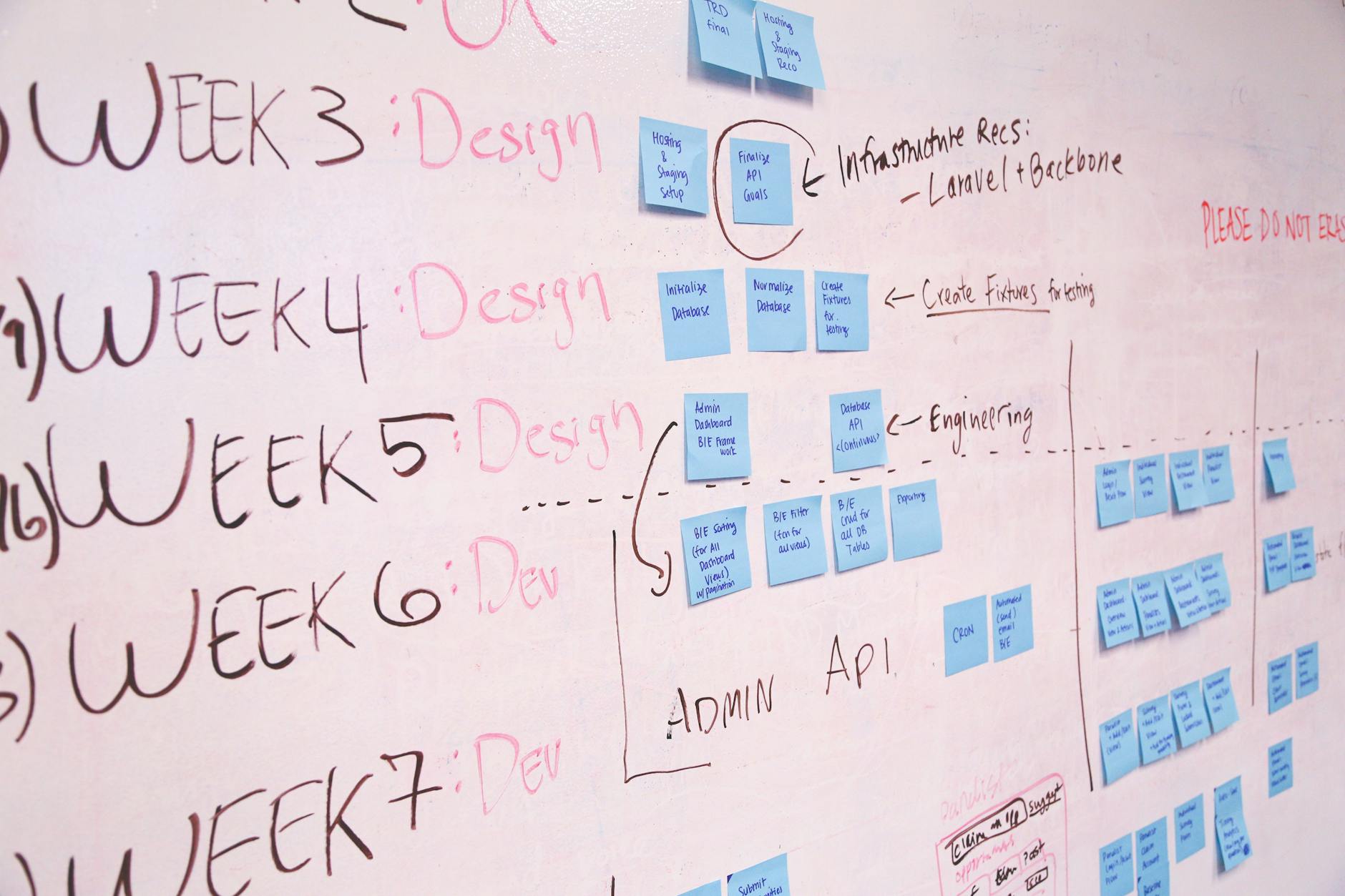
One of the most common planning mistakes is underestimating the time required for app development. A realistic timeline accounts not just for coding, but for design, testing, deployment, and unexpected delays. Break your project into phases with clear milestones and deliverables.
Consider using an agile development approach with iterative sprints. This allows for regular feedback and course correction throughout development. A typical app development timeline might include:
- Discovery Phase (2-4 weeks): Finalizing requirements, user research, and technical planning
- Design Phase (3-6 weeks): Creating wireframes, prototypes, and visual designs
- Development Phase (8-20 weeks): Building core functionality through iterative sprints
- Testing Phase (3-6 weeks): Quality assurance, user testing, and bug fixing
- Launch Phase (2-4 weeks): App store submission, marketing preparation, and deployment
- Post-Launch Phase (ongoing): Monitoring, optimization, and feature updates
Establish clear milestones with acceptance criteria. For example, "Milestone 1: Complete user authentication system" might require that users can register, log in, reset passwords, and maintain secure sessions. Each milestone should have associated deliverables, such as working code, documentation, and test results.
Use project management tools to visualize your timeline and track progress. Gantt charts can be particularly helpful for understanding dependencies between tasks. Remember to build buffer time into your schedule—industry best practices suggest adding 15-20% contingency time for unexpected challenges.
Budgeting and Resource Allocation
A realistic budget is essential for securing funding and managing expectations throughout development. Your budget should account for both direct costs (development, design, testing) and indirect costs (project management, marketing, maintenance).
Start by estimating development costs based on your timeline and resource requirements. Consider whether you'll build an in-house team, hire freelancers, or partner with an agency like FlutterFlow Agency. Each approach has different cost structures and implications for quality control. Our experience shows that partnering with specialized agencies often provides better value through expertise and established processes, though in-house teams offer more direct control.
Create a detailed budget breakdown that includes:
| Cost Category | Description | Estimated Cost | Contingency |
|---|---|---|---|
| Development | Programming, architecture, implementation | $XX,XXX | 15% |
| Design | UI/UX design, prototyping, visual assets | $X,XXX | 10% |
| Testing | Quality assurance, user testing, bug fixing | $X,XXX | 20% |
| Project Management | Coordination, communication, documentation | $X,XXX | 10% |
| Infrastructure | Hosting, domains, third-party services | $XXX/month | 15% |
| Marketing | Launch promotion, user acquisition | $X,XXX | 25% |
| Maintenance | Updates, support, ongoing improvements | $XXX/month | 20% |
Don't forget to account for ongoing costs beyond initial development. App maintenance typically costs 15-20% of initial development annually. This includes server costs, API fees, app store fees, and ongoing development for updates and improvements.
For resource allocation, define team roles and responsibilities clearly. A typical app development team might include product owners, project managers, UI/UX designers, frontend developers, backend developers, QA testers, and DevOps engineers. Smaller projects may combine roles, but ensure each responsibility is clearly assigned.
Risk Assessment and Mitigation Strategies
Every app development project faces risks—technical challenges, market shifts, budget constraints, and timeline pressures. Proactive risk management identifies potential issues before they become crises and develops strategies to mitigate their impact.
Begin by conducting a thorough risk assessment. Brainstorm potential risks across all project areas: technical, business, operational, and external. For each identified risk, assess its likelihood and potential impact using a simple matrix:
| Risk Level | Likelihood | Impact | Mitigation Strategy |
|---|---|---|---|
| High | Very likely | Severe | Develop contingency plan, allocate additional resources |
| Medium | Possible | Moderate | Monitor closely, prepare response plan |
| Low | Unlikely | Minor | Document, review periodically |
Common app development risks include:
- Technical risks: Integration challenges, performance bottlenecks, security vulnerabilities
- Business risks: Changing market conditions, competitor actions, shifting user preferences
- Operational risks: Team turnover, communication breakdowns, scope creep
- External risks: Platform policy changes, third-party service disruptions, regulatory changes
For each high-priority risk, develop specific mitigation strategies. For example, if you're concerned about changing app store policies, you might:
- Regularly monitor platform announcements
- Design your app with flexibility to adapt to policy changes
- Maintain communication with platform representatives
- Allocate budget for potential redesign if needed
Establish a risk management process with regular reviews throughout development. Designate a risk owner for each major risk category and ensure they have authority to implement mitigation strategies when needed.
Quality Assurance and Testing Strategy
Quality assurance (QA) is not an afterthought—it's an integral part of your development plan that begins during requirements gathering and continues through post-launch maintenance. A comprehensive testing strategy ensures your app meets quality standards, performs reliably, and provides an excellent user experience.
Develop a testing plan that covers multiple dimensions of quality:
- Functional testing: Verifies that features work as specified
- Usability testing: Ensures the app is intuitive and user-friendly
- Performance testing: Validates speed, responsiveness, and stability under load
- Security testing: Identifies vulnerabilities and ensures data protection
- Compatibility testing: Confirms the app works across devices, operating systems, and screen sizes
- Localization testing: Verifies proper functionality in different languages and regions
Incorporate testing throughout your development lifecycle using a shift-left approach. This means testing begins early in the process rather than waiting until development is complete. Implement automated testing where possible to increase efficiency and consistency. Manual testing remains essential for usability and exploratory testing.
Define clear quality gates—checkpoints where the app must meet specific criteria before proceeding to the next phase. For example, before moving from development to user acceptance testing, your app might need to:
- Pass all critical functional tests
- Achieve performance benchmarks (e.g., load time under 3 seconds)
- Resolve all high-priority bugs
- Complete security vulnerability assessment
Establish a bug tracking and resolution process. Categorize bugs by severity (critical, high, medium, low) and track them through resolution. Critical bugs that affect core functionality should be addressed immediately, while lower-priority issues can be scheduled for future updates.
Deployment and Launch Planning
A successful app launch requires careful planning beyond just submitting to app stores. Your deployment plan should cover technical deployment, marketing preparation, and operational readiness.
For technical deployment, create a detailed checklist:
- App store preparation: Create developer accounts, prepare store listings, gather required assets (screenshots, descriptions, icons)
- Backend deployment: Set up production servers, configure databases, implement monitoring
- Release management: Establish versioning strategy, create deployment pipelines, plan rollback procedures
- Analytics implementation: Configure tracking for key metrics, set up dashboards, establish reporting processes
Consider a phased rollout rather than launching to all users simultaneously. Start with a beta release to a limited audience, gather feedback, fix critical issues, then expand to broader availability. This approach reduces risk and allows for optimization before full launch.
Your marketing launch plan should align with technical deployment. Coordinate app store availability with marketing campaigns, PR announcements, and user onboarding. Develop launch materials including press releases, blog posts, social media content, and email campaigns. For more on effective app launch strategies, see our comprehensive guide on successful app launch planning.
Prepare your support team for launch. Develop documentation, train support staff, establish communication channels for user feedback, and create escalation procedures for technical issues. Monitor app store reviews and social media mentions closely during the first weeks after launch.
Post-Launch Optimization and Roadmap
Your app development plan doesn't end at launch—successful apps evolve based on user feedback and market changes. Your post-launch plan should include monitoring, optimization, and future roadmap development.
Implement robust analytics to track key metrics established during planning. Monitor user behavior, performance data, and business metrics daily during the initial launch period, then weekly or monthly as usage stabilizes. Set up alerts for critical issues like crashes, performance degradation, or security incidents.
Gather qualitative feedback through multiple channels:
- App store reviews: Monitor ratings and reviews regularly
- User surveys: Collect structured feedback on specific features or experiences
- Support tickets: Analyze common issues and user frustrations
- User interviews: Conduct periodic interviews with representative users
- Analytics: Identify usage patterns, drop-off points, and feature adoption
Use this feedback to prioritize improvements and new features. Maintain a product backlog of potential enhancements, regularly reviewing and reprioritizing based on user value and business impact. Consider implementing a regular release cycle (e.g., monthly updates) to deliver continuous value to users.
Develop a long-term roadmap that aligns with your business objectives. Your roadmap should balance:
- Maintenance: Bug fixes, performance improvements, security updates
- Optimization: Enhancements to existing features based on user feedback
- Innovation: New features that expand your app's value proposition
- Technical debt: Refactoring and infrastructure improvements
Regularly review and update your roadmap based on changing market conditions, competitive landscape, and user needs. Maintain the agile mindset that served you well during initial development, remaining responsive to new opportunities and challenges.
Measuring Success and Iterating
The final component of your app development plan is establishing how you'll measure success and use those measurements to drive continuous improvement. Return to the KPIs you established during planning and track them rigorously.
Create a dashboard that displays your key metrics in real-time. Include both leading indicators (metrics that predict future performance, like user engagement) and lagging indicators (metrics that reflect past performance, like revenue). Regular review cycles—weekly for operational metrics, monthly for strategic metrics—ensure you stay informed about your app's performance.
Conduct periodic business reviews to assess whether your app is meeting its objectives. These reviews should involve stakeholders from across your organization and address:
- Financial performance: Revenue, costs, ROI
- User metrics: Acquisition, retention, engagement
- Technical performance: Stability, speed, reliability
- Strategic alignment: Progress toward business objectives
Use these reviews to make data-driven decisions about future investment. If certain features aren't delivering expected value, consider deprioritizing or redesigning them. If user acquisition costs are higher than projected, explore alternative marketing channels or referral programs.
Remember that app development is an iterative process. The most successful apps continuously evolve based on user feedback and market changes. Maintain the planning discipline that got you to launch, applying the same rigorous approach to post-launch optimization and future development.
Conclusion: Turning Planning into Results
Creating a business app development plan that actually works requires discipline, thoroughness, and strategic thinking. By following the framework outlined in this guide—from defining clear business objectives to establishing post-launch optimization processes—you'll significantly increase your chances of developing a successful app that delivers real business value.
Remember that your development plan is a living document, not a one-time exercise. Regular reviews and updates ensure it remains relevant as your project evolves. The most successful app development teams maintain planning rigor throughout the entire lifecycle, from initial concept to mature product.
At FlutterFlow Agency, we've helped hundreds of businesses transform their app ideas into successful digital products through comprehensive planning and expert execution. Whether you're just beginning your app development journey or looking to optimize an existing application, the principles outlined in this guide provide a proven framework for success.
Ready to put these principles into practice? Download our app development planning template or schedule a free consultation with our expert team to discuss your specific project needs. With the right plan and the right partner, your app can become a powerful driver of business growth and customer value.